

creative prompts for making the work you actually want to make
be wild, be feral, be free.

The monthly creative prompts email is here! Before you dive in, rest assured these words were written using 100% human intelligence. I do not use AI in my work. I’m AI Sober and it feels delicious. You can read my full AI Policy here.
Gentle reminder that if you want me to read the dispatches here out loud to you, I started recording them as podcast episodes. The Persistent Bloom podcast is back and I’d love for you to listen and leave a review.
Want to respond to these creative prompts and share your work in community with other artists from around the world? Join the Persistent Bloom Discord Server!
One final heads up, I’ll be teaching an in-person Drawing 101: Materials and Techniques to Start Workshop on Monday, August 17th from 6-8PM at Diablo Valley Art Supply in Walnut Creek, CA. Save the date, more info to come in the next dispatch.
We all have ways we want to be creative that feel forbidden, secret, unwise, wild, not ideal for public consumption, tender. These are often ways we loved to create when we were younger, more full of wonder, less influenced by the need to make money with our art or practicalities of what we should be doing. In this era of AI slop, it is imperative for us to look at any influence towards optimization with a very critical eye. We do not need to be machines. We must put our intuition and imagination at the center of our artistic universe. That’s what these prompts1 will help you do this month.
I take most of my inspiration from nature. The plants teach me that we can’t farm an art practice in the same way we do food. Even then, the need to optimize degrades Quality.2 Can you honestly tell me that a Safeway tomato3 — picked too early and shipped too far — is as delicious as one from your garden or local farmers market? It’s just not. Every time I buy a grocery store tomato, they are usually bland with a subpar texture. There is no comparison to the taste of wildness, of letting something gently ripen on the vine until it is just right for harvesting. When all you need to enjoy the tomato is to slice it with a drizzle of olive oil and salt.4
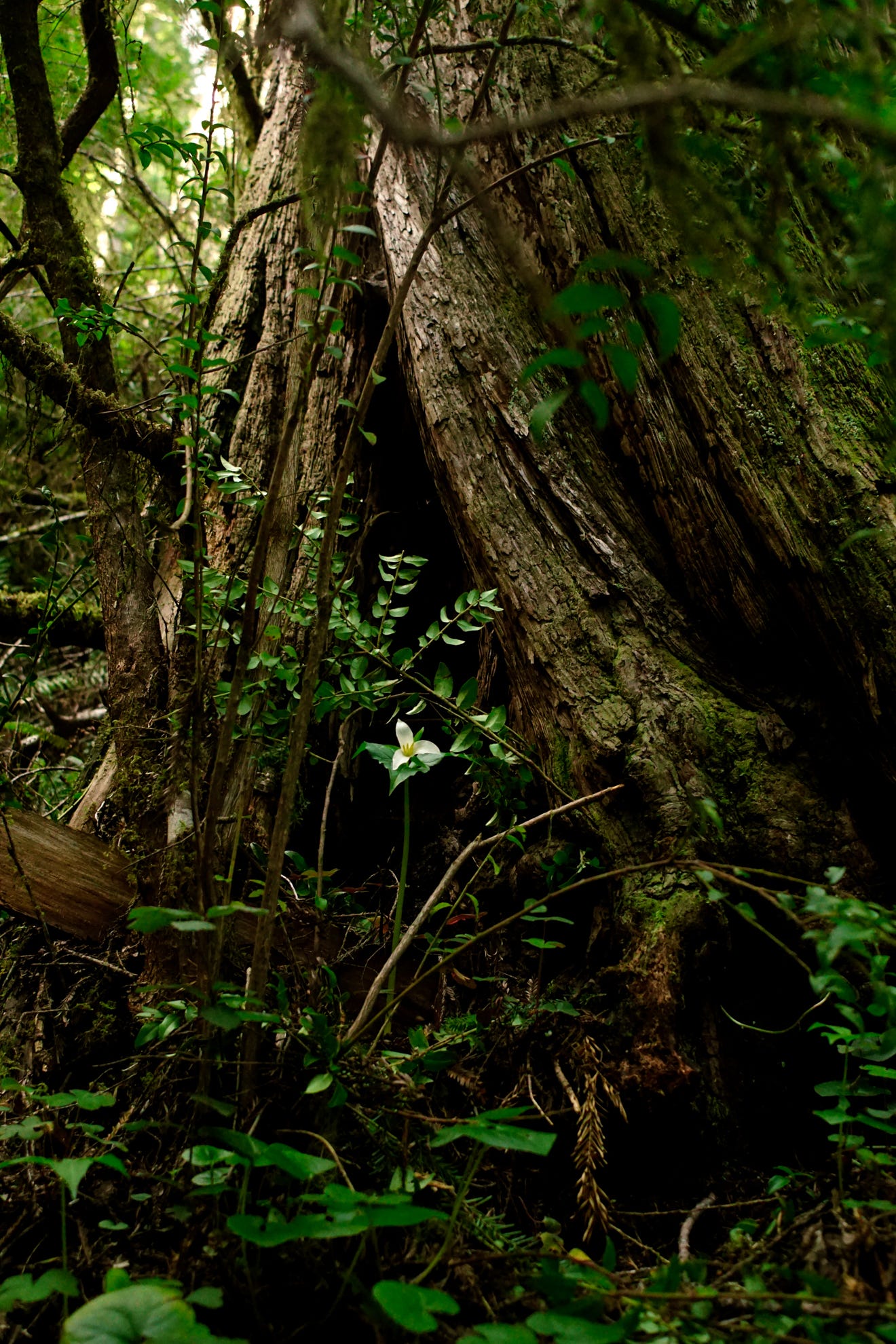
This March I went camping on the Northern California Redwood Coast, home of the tallest old growth trees in the world. Pulling into our site, I noticed a flower growing nearby and was mesmerized by its beauty. “a Trillium! oh my god… three of them!” my friend Hilary cried out “these only grow in the wild, they can’t be cultivated, and they are so, so rare!” Walking over, dodging Poison Oak to look closely and notice deeply, I wondered, what was the purpose of these plants? What were they trying to tell me?
This experience got me thinking about the wildness of beauty, the magic we often try to chase in our work as artists, but it can’t appear on demand. Not everything we create will have the same kind of magic or resonance with ourselves or the people we share it with. Sometimes, showing up to make is just practice. Other times, it can be an all consuming and wondrous journey. So, what gives? What makes the process of creating things feel so wonderful and wild?
Let’s consider the Trillium’s lessons.
As I hiked along the Grove of the Titans, I saw Trillium after Trillium in the forest. More of these rare and magical flowers blooming alongside the most magnificent and gigantic trees I have ever witnessed. These trees were so large they had whole new trees — often Western Hemlock — growing on their lower branches. The spirit of the woods was telling me to embody these crone trees. I needed to be wilder, to follow my own intuition, to deepen into what was fun and full of pleasure. I needed to make what would set me free. When I got home from the trip, I started painting feverishly. Making experiment after experiment in my sketchbook.
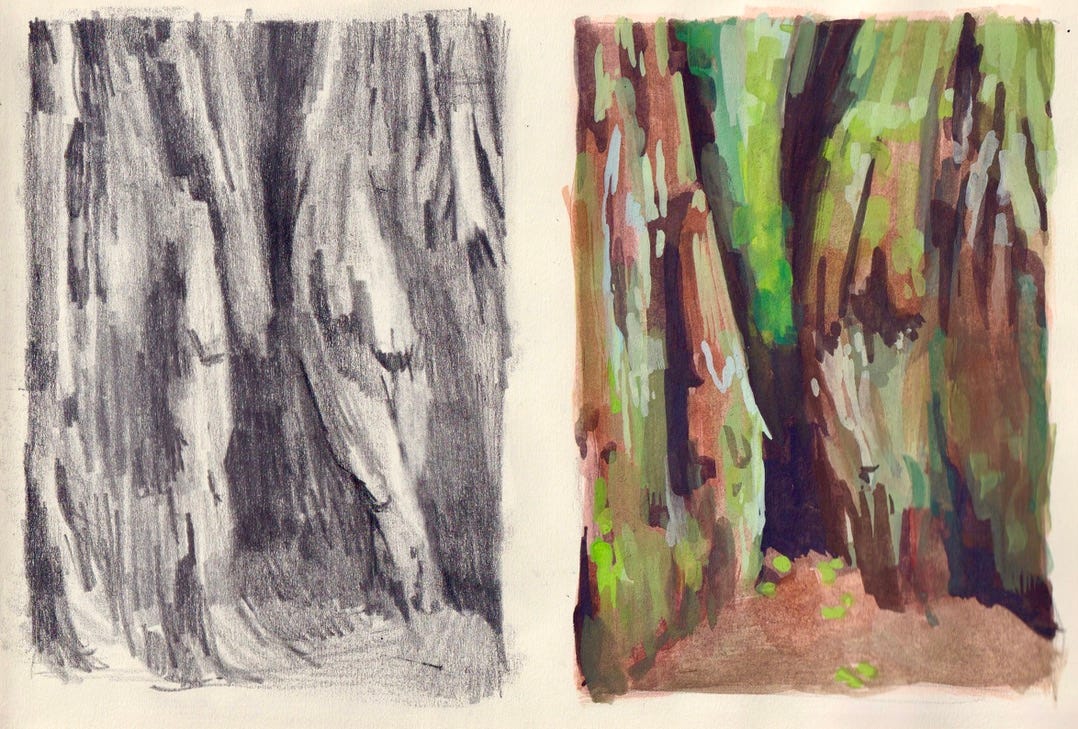
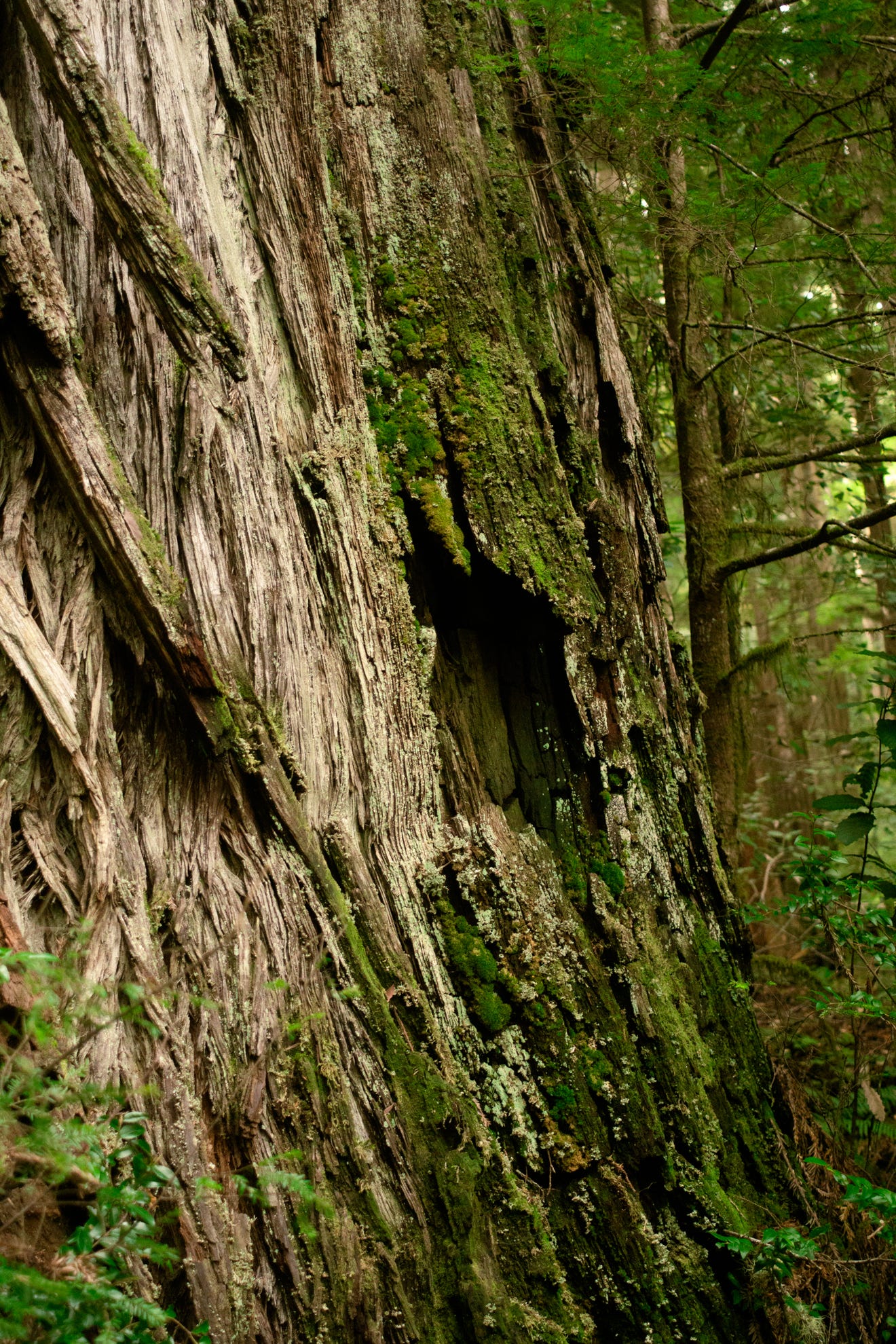
Discarding the need to make universally palatable things, I channeled my inner Georgia O’Keeffe and started painting holes and lichen covered bark. Deepening into the sensual, bodily forms of these giant trees, I could see they were figurative, so deeply alive. I’ve been collecting images of holes in nature for over a year and have been too afraid to paint them. Nature is so gorgeously queer. Seeing my own humanness in these beings reminded me they are sensing and wise.
As a professional artist I am saddled with guilt and shame when I allow myself to follow this feral desire to paint holes.5 It’s the conditioning of social media. The need to perform my most wide-reaching HR approved version of my art. Would O’Keeffe have given a single fuck about what she should be making? Absolutely not. She was wandering in the desert collecting bones and rocks. The bodily forms of her landscapes called out to me permission. There is a fear of making things that aren’t commercially viable, that could repulse a stranger at a makers market, that are too “weird.” But the weirder I got, the freer I felt.
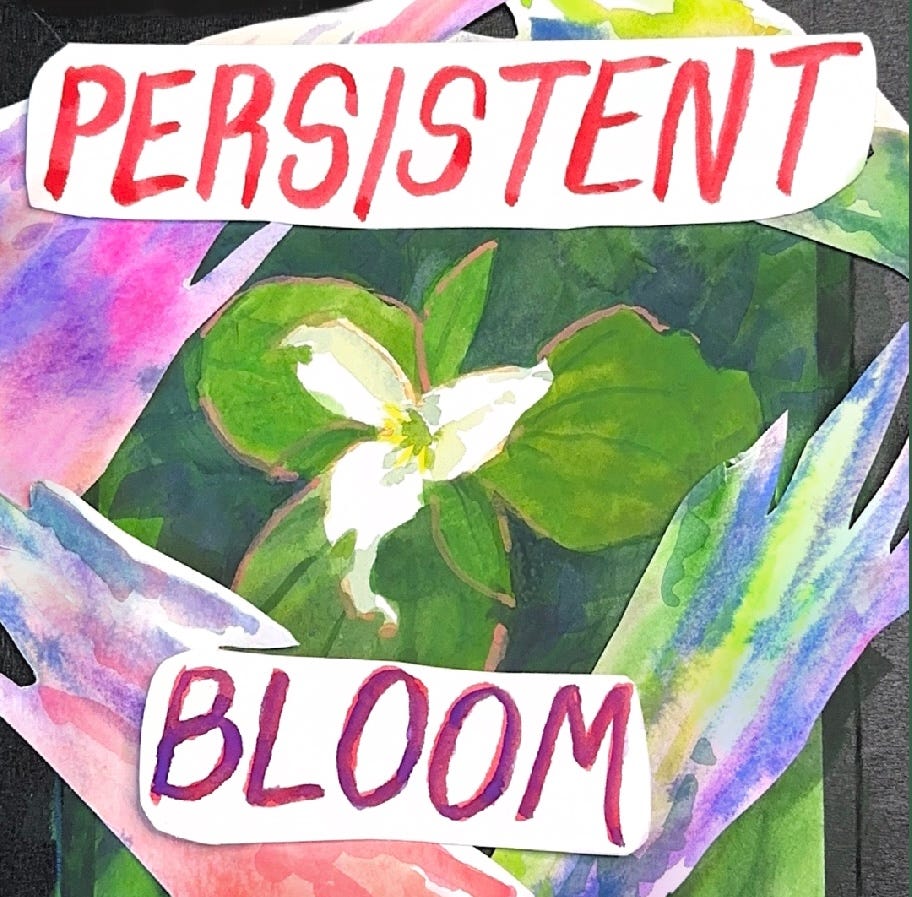
In addition to painting these holes, I started cutting up some of my paintings, layering them as collages. Eventually I landed on this experiment on some watercolor paper, collaged onto a pink and purple infused a portrait of a Trillium. My new podcast cover art was born.
When we follow the wild, it feels terrifying and vulnerable. But the wild and feral parts of our art are where our humanness lives. In this moment, where people feel compelled to prove how human we are, we must to tap back into our wildness. There is beauty in allowing the parts we think we shouldn’t pursue to have a central place in our lives once more. Our inner kids need it.
Here are some creative prompts to consider your wildness this month:
What is an impractical belief you have about your art practice?
What do you tell yourself not to do, or to make sure you avoid?
Have you stopped making a certain kind of art, music, writing, or other imaginative work because it is not commercially viable or practical?
What would it look like to let that work back into your life this month?
What would it mean for you to make the work you feel is the most risky? How can your work be the most colorful, sensual, and potent in an increasingly builders-grade grey6 world?
How do you stop following logic, systems, or rules you have come to make rigid and rely on?
How can you make art as if it is an act of survival?
Once you play around with these prompts, I want you to explore what it would mean to consider them with people in your in-person, real-life, meatspace community. Please chat about this with another human and email me your observations! I wanna know!
Showing up for ourselves instead of machine results.
On the same camping trip with the Trilliums, I happened to pickup a copy of Words Are My Matter, a collection of essays by Ursula K. Le Guin. I am so inspired by her sharp wit and observations about how creativity is mangled by late stage capitalism. The book opens with her writing in the The Operating Instructions :
“A poet has been appointed ambassador. A playwright is elected president. Construction workers stand in line with office managers to buy a new novel. Adults seek moral guidance and intellectual challenge in stories about warrior monkeys, one-eyed giants, and crazy knights who fight windmills. Literacy is considered a beginning, not an end.
Well, maybe in some other country, but not this one. In America the imagination is generally looked on as something that might be useful when the TV is out of order. Poetry and plays have no relation to practical politics. Novels are for students, housewives, and other people who don’t work. Fantasy is for children and primitive peoples. Literacy is so you can read the operating instructions. I think the imagination is the single most useful tool mankind possesses. It beats the opposable thumb. I can imagine living without my thumbs, but not without my imagination.
The creative imagination is a tremendous plus in business! We value creativity, we reward it!” In the marketplace, the word creativity has come to mean the generation of ideas applicable to practical strategies to make larger profits. This reduction has gone on so long that the word creative can hardly be degraded further. I don’t use it any more, yielding it to capitalists and academics to abuse as they like. But they can’t have imagination.
Imagination is not a means of making money. It has no place in the vocabulary of profitmaking. It is not a weapon, though all weapons originate from it, and their use, or non-use, depends on it, as with all tools and their uses. The imagination is an essential tool of the mind, a fundamental way of thinking, an indispensable means of becoming and remaining human.”
I put the book down and sat with that passage. Being an artist for a living means I have confronted this idea of the word creative getting mangled over and over. My job title at Apple was Creative, but near the end, I spent 95% of my days fulfilling web orders and selling cases for iPhones. A fancy title for labor that was no longer valued. Similar to my recent frustrations with working for YouTube, how it was feeling more and more like another dead-end job in the gig economy. What does it meant to be a creative person in this era of profitable contortions and degradations?
My intention with starting YouTube was to make adventure vlogs, sharing the story and practice of my art. But that isn’t what performed well. What the platform liked was video essays, commentary, things that distracted me from the work of imagination. Again I was confronted with the way machines try and tame our work. I stopped painting and was spending 90% of my weeks writing and studying the craft of video to try and recreate a past success. In the work I was making, I found myself pushed to strip out things like the references to the tarot or how the forest made me feel. Those were things that would alienate people. It would make it harder to be a commercially viable brand, to have products with the widest possible appeal.
I was not being guided by freedom, I was operating out of scarcity and fear. I abandoned my imagination to be a Good Creative. Following the whims of a machine telling me what could earn the widest appeal and watering down my soul in the process. I was playing everything so safe and was so worried about the perception of my work. There weren’t risks being taken. I was just going through the motions to make paintings that I thought would lead to a “watchable” process video for Reels, Shorts, or Tiktoks. What a terrible way to guide my studio practice!
The hardest thing about being an artist in this era is how our work has been devalued and demoralized, stripped of authenticity or our true curiosity, to match commercial and algorithmic demands. We see people on our feeds finding success and notoriety for following their passions. We don’t know how much of it is just luck and start saying why isn’t that thing happening to me? Maybe these machines could tell me the things that art school couldn’t? How to be a good business owner. How to make fire content7.
If I wanted to be successful I had to use a peppy vocal cadence, I had to have more optimized hooks, more hot takes, more ways to hold people’s attention. Going through my old notes and seeing these instructions I was writing to myself, something wasn’t right. Despite knowing how to follow recipes for driving results, none of the changes I was making were working in a way I could rely on. I just wanted to build depth and relationships with people to make them trust me and want to buy my art.
Most of the patterns we find in social media virality are completely and utterly random. Our attempts to mimic them are a form of superstition. As Cory Doctorow put it brilliantly recently, superstition is:
“when you misunderstand the causal relationship between two phenomena and you do it over and over again, right? Every time I wear my lucky hat, the sporting gentlemen of my favorite team are triumphant on the field. Therefore, I will wear my lucky hat every time. And then if they don’t win, it’s like I wore my lucky hat wrong. it’s a deliberate use of superstition”
Trending audio, repeating past successes, trying to follow the patterns is superstition. I was losing time and motivation to dedicate to my easel. I was fully committed to making content but it was dead material, lifeless, bland, a perfect average. On occasion I would give myself permission to just paint whatever I wanted and these sessions would lead to a real sense of longing to free myself.
Here’s an exercise to help you get more free.
If you are still reading at this point you’ve probably been in this position. Frustrated, pulled towards the idea that you just have to keep making more of the same thing in perpetuity, even if that wasn’t the thing you even wanted to make in the first place. Here is an exercise to break free from the algorithmic conditioning.
Keep reading with a 7-day free trial
Subscribe to Persistent Bloom to keep reading this post and get 7 days of free access to the full post archives.