

let's build your foundation for the new year
How to have a "dry January" from big tech thru these human-centered journal prompts

This week, our minds have shifted into planning for 2026. I love this stuff, imagining what’s possible on the precipice of a threshold. New stationary, decorating planners, setting resolutions or intentions, all of the strategies we use to infuse our lives with hope.
I’m dreaming of a 2026 that is physically heavier with tote bags full of one-track objects. An analog bag full of the things you would bring to a slumber party at your friends house as a teen: sketchbooks, crayons, markers, knitting/crochet projects, a CD/MP3 player, a digital camera, a book, notebooks, tiny instruments, paper planners, and a phone that’s just a phone.
Our phones are portals that promise connection but provide distraction. Many hours of our year will be given freely to tech, pulling us from our ability to think and getting us stuck in loops of distraction. For me, the pull averages out to 4 hours a day. That’s 28 hours a week or 1,456 hours per year, and that’s only my phone!
This pull is not your fault. It is not an individual failing. These things are made to be addictive, habit forming, and trick us into using them for the wrong purpose.
Sometimes I go to write down an idea in the Notes app but I automatically check my email, or a text message comes through and pulls me out of my idea-generating mode of thinking. I feel compelled to task switch and respond. Having everything accessible all on one device is actually a nightmare.
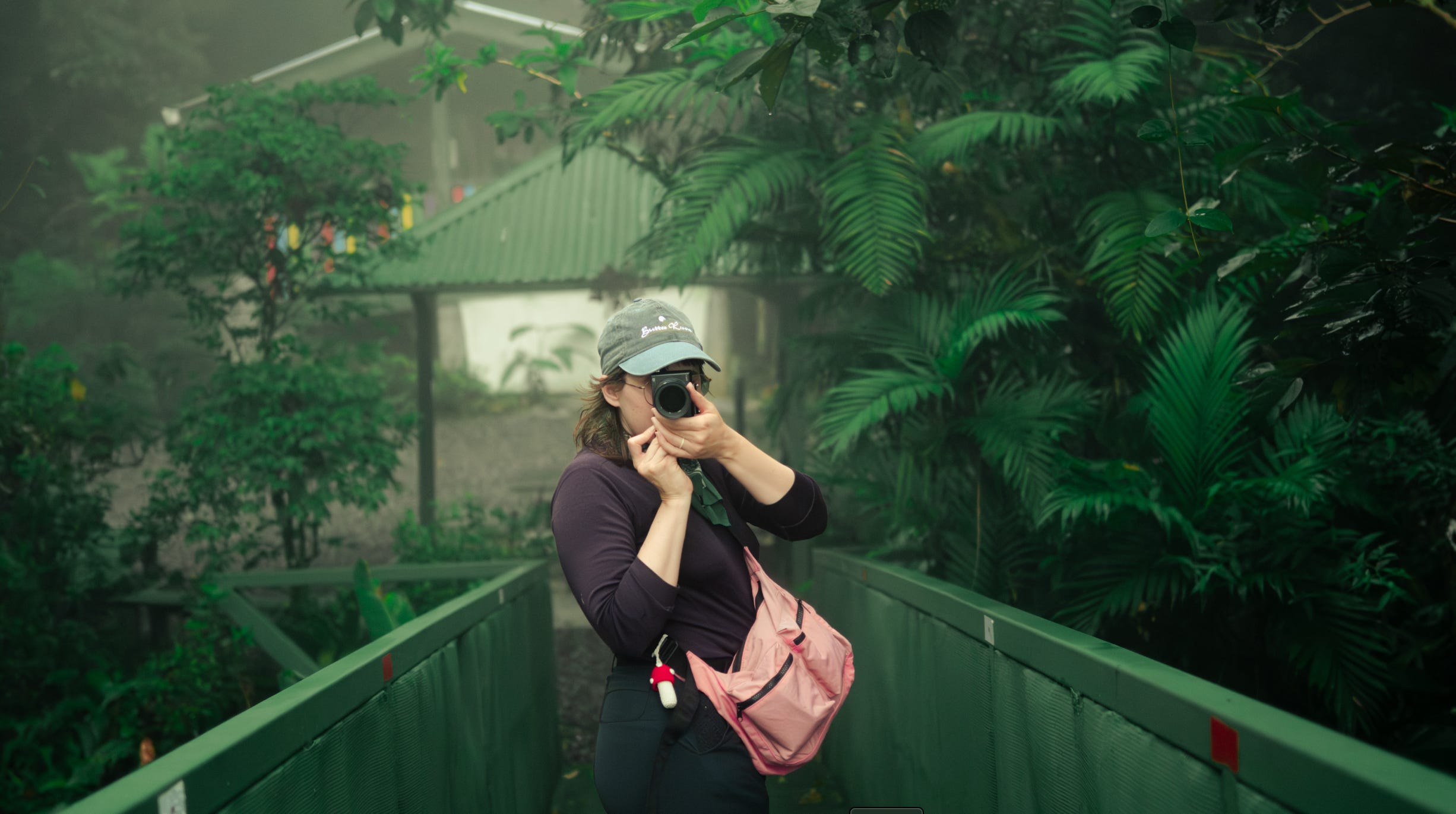
Just switching to a paper pocket notebook for the last 3 days has led to a 44% drop in screen time. I’m committed to switching to analog for as much of my creative and idea capture process as possible in 2026. I have seen the impact using a camera without notifications has had on my creative voice. The potential of accessing everything from one device means our habituated and default settings are going to win out every time.
Despite discussing my own changes, and providing individual suggestions in the words ahead, I must remind you, that breaking free from tech isn’t just an individual struggle. We need to recognize that through community — not just personal “good habits” — we can find freedom and accountability to shift our attention back to connection instead of capture.
I know we need to commit to a more analog life together, as a collective.
This year was transformed by joining a knitting club, giving my attention to building in-person solidarity with other creative humans. Online, the growth of the Persistent Bloom Discord community has been a boon to using the internet in an enriching way. Talking with others in a decentralized space to prioritize our creative practices together.
These spaces helped me talk through big issues like screen time, social media fasts, and even more potent and rampant right now, ai dependence and psychosis that are collectively harming us. Things that are often referred to as “tools” or “toys” are being built to hook users into deep isolation and addiction. Which is why advocating for ai sobriety feels so vital to my work.
I’m teaching creativity in a world where the pressure from the tiny screens in our pockets is keeping us from wanting to make the choice to move towards the things that enrich us. To quote my spouse while we were looking at the incredible Divergence of Birds project tearing up, Wes said astutely “the point of art its to wake your heart up!”
SO, if you’re ready to have an awake and open heart, you need to have clear written reasons to guide you back to art for when (not if, honey, we are all human) you fall back into old patterns. Truly, having a foundation that will remind us to tune into ways that will feed our work is the first step in the process.
Build your Analog Foundation for 2026, a workshop!
So of course, I did this work in community first. On Saturday, January 3rd I taught a one hour workshop for my Discord community and paid Substack members but now, it’s available as a recording for only $22!
Purchasing the workshop is a great way to support my work and see what it’s like to witness my teaching style for a super low promo price! This year I will be teaching analog art practices online A LOT and as a reminder you can see all the classes I am dreaming up and planning right here. I choose what I teach based on waitlist signups or community needs because I believe in putting y’all at the center.
You can also do this work solo, but I have two requests:
Send this post to a friend who will do this with you. The one who always complains about their phone, who wants to quit Instagram but hasn’t, the friend who is questioning their use of ai, the folks who just wish they could access their creativity but it feels far off. Please, do this with them, preferably in person OR on a video or phone call. Then set times throughout the year y’all will connect again and discuss where you’re at and how you need support to keep going. This is how you will stick to this, together.
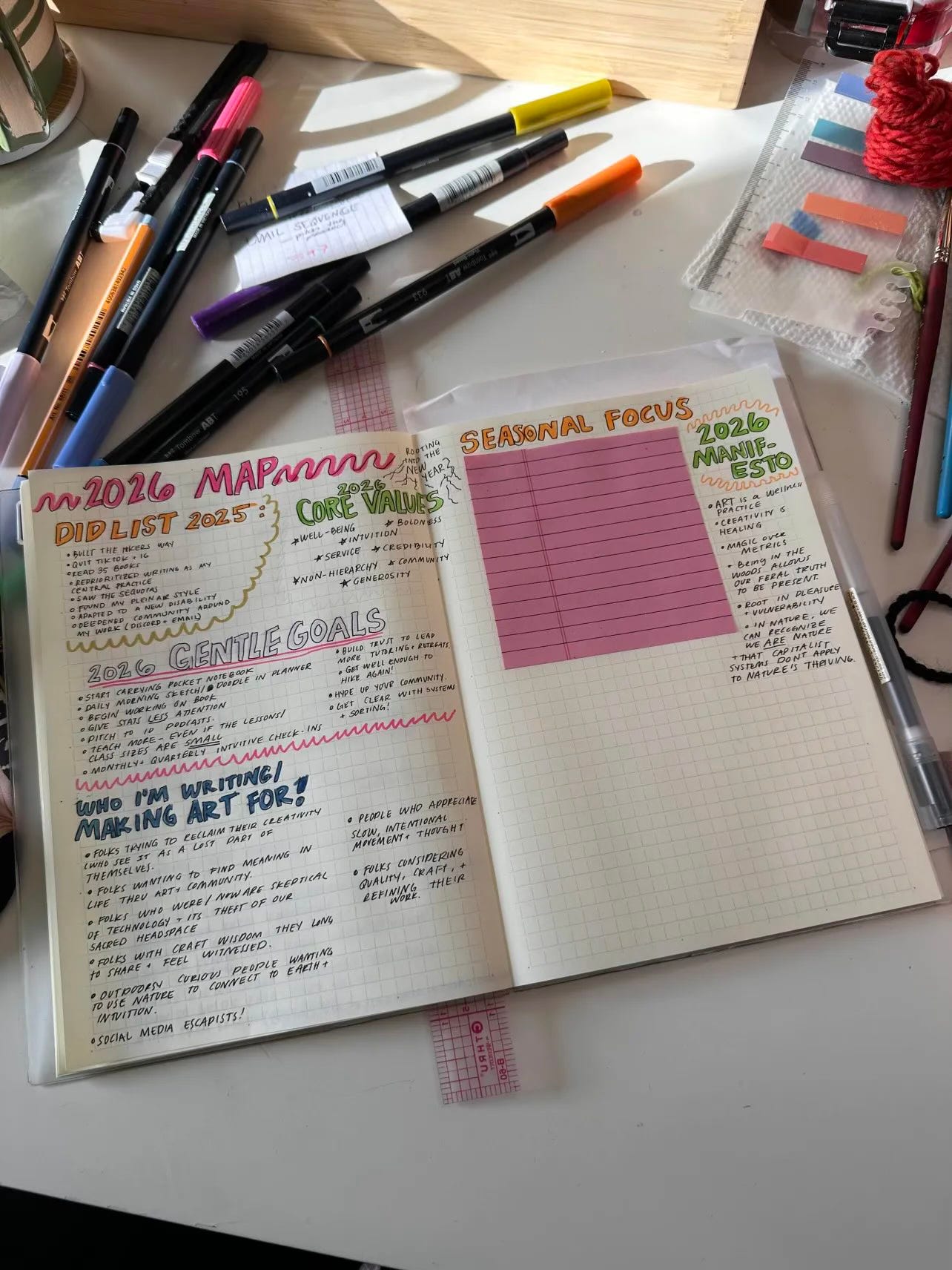
Write your final responses down in an analog book of some kind you can carry around with you or on some paper you can tape to the wall of the space where you like to make things or get ready in the morning. I’ll admit, I did this all in Notion first (which I will share in the workshop) and then once I let the ideas ferment, I committed them to paper with ink and marker in my commonplace book. I do have the Notion Template to do this and sort ideas as they come in and out of your analog systems for sale on my website too in case you want this to feel easier.
Step 1: A Did List
This is the most important part because it helps you reflect on what you have done. What was actually possible for you this year given your life and circumstances. It is way too easy to look towards a new year with unrealistic and unsustainable ambitions. If we start by looking back instead of looking forward, we can gain deeper insight into ourselves and what really mattered.
The Did List is also an important community reflection for me, as I was taught this practice by my former Drugstore Studio mate Kate Horvat. My time in community with Kate and others like her shaped my values and priorities as an artist to make sure that my work is always rooted in community with others and in protecting the practices of those in my community. You can read about our struggle with eviction from this space in this great article by my friend Emily Cox.
Take 10-15 minutes and look back at the year and answer the following:
What were the small things that stuck with you?
What songs, films, books, or artworks that you kept coming back to this year?
What were the things that stood out to you as meaningful?
What changed in your life or worldview?
What were your biggest achievements? (notice how this is last?)
Now that you have this list, go on a walk. You can come back to this post but seriously, grab a piece of paper and go on a walk and see what else comes up for you. Yes, I know it’s probably cold but I know you have long underwear and gloves somewhere for this purpose! Come back and do the next step once you’re done.
As a reminder, the Did List is a great tool to come back to throughout your year. If you liked this exercise, I have a whole video about it to guide you through a few more versions. I like to do these monthly in my commonplace book. You might like to do them on a Notion dashboard or on a post-it you tape to your wall as a reminder of what you accomplished. Whatever works for you!
Step 2: It’s Time to Root into Our Values
Having our values as a lighthouse on the rough sea of society is essential. We can be so easily pushed and manipulated by the systems of power-over in our society. It is hard to see what we truly want, rather than what we are conditioned to want or believe. A core values exercise is a tool from Cognitive Behavioral Therapy1 and you can find lots of examples online to walk you through the steps.
It usually goes as follows:
Take the big list and underline as many words that you relate to.
Sort those words on the list into categories based on their general affinity
From those categories, try to pick one word (this is hard! I always break this rule.)
Write down the favorite words from your categories.
This year, my core values are well-being, boldness, intuition, service, credibility, non-hierarchy, community, and generosity.
Often times the lists you find online have language that upholds the current exploitative and capitalist systems that make it hard to make art and root your values outside the concept of rugged individualism. The over culture is hyper-individualist. Be wary of the language on the list you find! Print them out and cross things out ruthlessly that you don’t dare consider.
If you want a little help, I did the work of making a core values exercise that is deeply considerate of this language as a part of Cycle Zero of The Hikers Way. You can snag that four episode pod-class for just $27 and be guided through this exercise and others by my voice anytime here. And folks who purchase Cycle Zero get a big discount on the main experience of The Hikers Way too!
As a gentle reminder, I do not take sponsorships and make most of my income through my teaching practices. Paywalling portions of my work allows me to provide for myself. If you love this post and want to support me, consider subscribing or buying me a coffee.
Step 3: Who is this For?
We must root in community this year, considering the conversations we are inviting with our work and the people we want to talk with. Too much of culture is about individualism, hustle, and our own personal development which is where I think self help often fails.
This is also why I absolutely cannot stand ai “art” or “writing.” Beyond the ways ai (and in some ways also social media) divorces us from the bodily and intuitive, on a broad scale it alienates creative people from the thing they need most: community.
When artists make physical work, they need studios, space, and material resources. That ends up requiring that they are in struggles (whether they like it or not) with other artists and members of once affordable communities against the forces of capital that displace them all. I lost my studio space in 2019 and quit painting because I couldn’t afford another adequate space to continue.
ai not only affirms our ideas as wonderful, but it divorces us from material reality, it isolates people deeper and deeper into wormholes of isolation and cognitive biases. ai “art” is art for the individual (or corporation) only. It is product divorced entirely from process. It isn’t real art because it doesn’t have any stakes or investment in community.
So, who is your work for? Who do you want to make for? Let’s answer these.
What questions are you asking or trying to solve with the work you are making?
What problems drive you to research and seek out answers from others?
What gives your life meaning? What aspects of that are through community?
Who do you wish you could connect with?
What are your favorite places to go and why? How might you want to improve them?
If you were to teach a class or give a lecture, what would you talk about? (need inspiration for this? watch this lecture by Hank Green on grocery stores!)
Did you, like me, once have incredible hope for the internet as a connective force? How can you find analog equivalents of that?
Answering these questions helped me arrive at the following, and I hope you see yourself in one or more of these categories.
Folks trying to reclaim their creativity, who see it as a lost part of themselves
Folks wanting to find meaning in life through art, craft, and community.
Folks who were or are now skeptical of big tech and its theft on our sacred headspace.
Folks with craft wisdom they long to share and hope to feel witnessed.
Folks considering quality and craft, hoping to refine their work.
Folks who are curious about the outdoors, using nature to connect with the earth and to our intuition.
Folks who appreciate slow, intentional movement and thought
Folks who want to live a more analog and intentional life.
Step 4: Gentle Goals Intentions
This is the part where we can now look forward. Informed by our previous year and our values, we can set the intentions for how we plan to use are time and move through the new year. Remember that the time we reclaim back from big tech we need to invest in empowering ourselves. These can be really tiny goals intentions like:
Something tangible without pressure to do anything: Start carrying a pocket notebook
A habit and/or practice you would like to engage with more often: Doodle in the weekly view of your planner
An experiment you'd like to run that would improve your life: Test new idea inbox systems that work with your brain, rather than against it
A way to connect with someone’s writing or ideas more deeply: Listen to a book or podcast while knitting or making art
A way to connect to your creativity: I will bring a marker, a pen, some crayons, and my sketchbook with me in my bag.
Something for your health: Get back to daily walks, no matter how short!
A way to put yourself out there: Pitch conversations to 10 podcasts or email 10 old friends to have coffee and reconnect.
You don’t need to write something for all of the examples above, but it is helpful to acknowledge what you need, based on your responses to the earlier exercises.
Step 5: Write a Manifesto
I believe I have said it before, but some of my best motivation comes directly out of opposition to something, writing a manifesto is a perfect exercise to see the ways that you want to take action this year.
What does it mean to act in accordance with your values and intentions in a way that compels you to action?
Can the statements you write encourage you to be more radical and take a stance?
Can the statements inspire others to join you?
Are there things you want to call out?
What have you had enough of (things limiting you, cultural stuckness, the billionaire apparatus?)
Is there a level of activism or direct action you want your work to engage with this year?
If you need some inspiration, check out the Guerrilla Girls ManifestA for Art Museums Everywhere or Ben Davis’ 9.5 Theses on Art & Class. You probably have other favorites that you should share with me in the comments.
Step 6: Add Reminders
We all have favorite books, strategies and quotes that we need to have around as reminders to why we are doing what we’re doing. For me, it’s the core principles of Emergent Strategy from adrienne maree brown’s excellent book of the same title. I also love to read and reread the 8.9 from Ben Davis’ 9.5 Theses I mentioned earlier
“Creative expression needs to be redefined: It should not be thought of as a privilege, but as a basic human need. Because creative expression is a basic human need, it should be treated as a right to which everyone is entitled.”
Go through your favorite books and pay attention to what you underlined or where you wrote exclamation marks in the margins. Look at your digital book device notes and highlights and pull your favorites. Rewatch that one TED talk you can’t stop thinking about and take notes this time.
Step 7: Make it Yours
Now, the final step is where you add images, print outs, collage, markers, crayons, doodles, anything you want to make it feel like your own. Maybe you draw something inspiring on the opposite page or page right after. Use this space however you want to keep you inspired and rooted in what you want to be doing and why you want to be doing it.
Creativity, writing, art, music, clothing, objects made with human hands and our human intelligence will guide us towards a space of joy, hope, and open up our rich inner world. I hope this structure inspires you to make and invite others along the journey with you back to your sacred and beautiful human creativity.
If you really resonated with something in this dispatch, respond to this email. I’d love to hear from you.
One final note, if you have been eyeing my Gouache and Watercolor class but the time hasn’t worked for you yet, the self-guided version will be $89 and will go on sale sometime next week. I changed the price from $109 to $89 to make it more accessible. I’d love to have you be one of the first to know about it by signing up for the waitlist here.
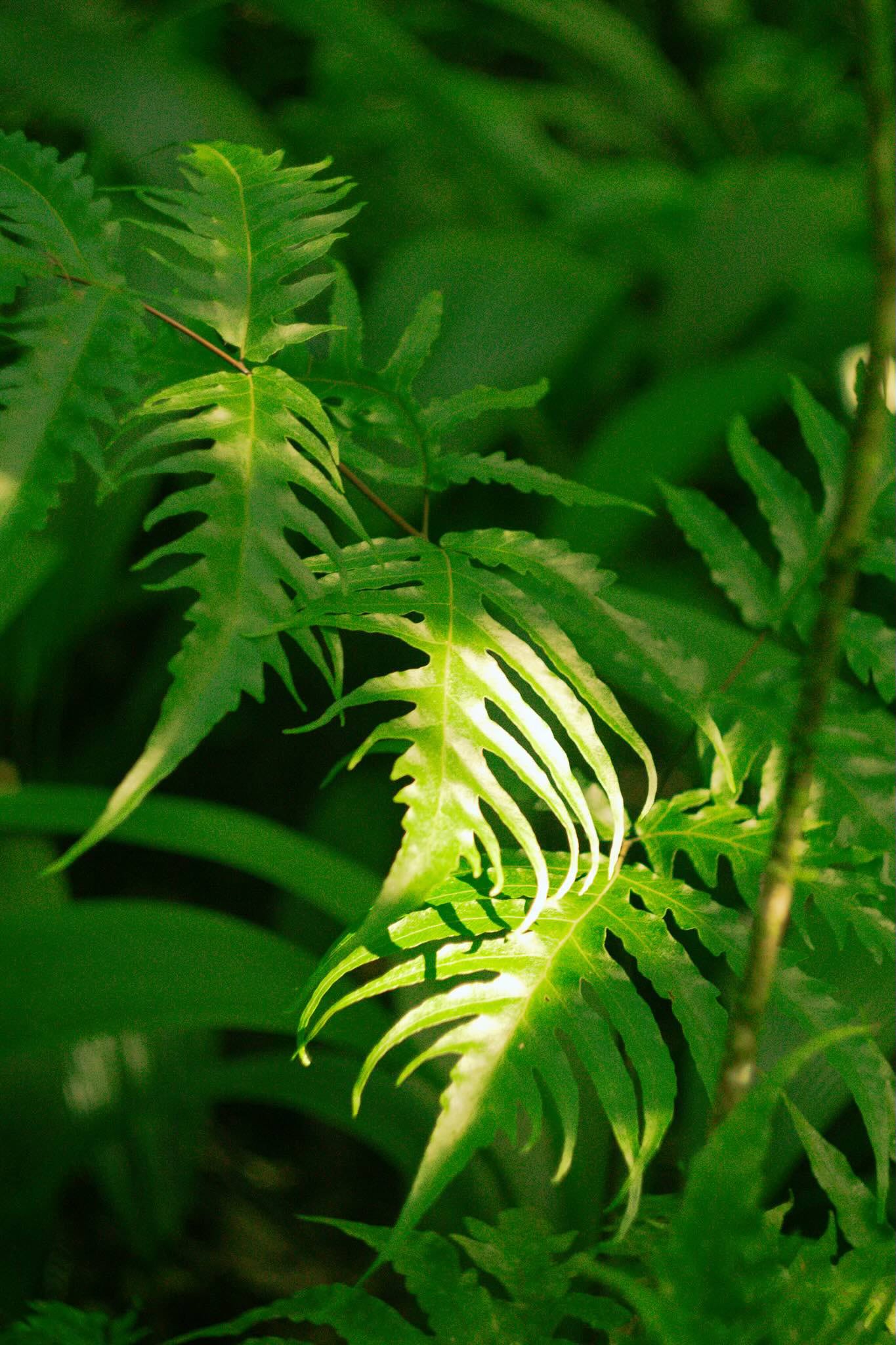
If you loved the images in this post, consider subscribing as a monthly or yearly patron to support my work. My paid subscribers get access to my full photo reference library of adventures like the Eastern Sierra, Sequoia National Park, and Big Basin Redwoods. This month they are all from my recent trip to Costa Rica. I’m super excited to continue seeing what these folks make with the images (the best part of sharing them tbh)
Until next time, stay creative and find your own ways to persistently bloom.
-Mel
but I am not a therapist! so you might want to do this work in tandem with a mental health professional, especially if you are really struggling this winter. I always want to normalize therapy, as I have depression, anxiety, AuDHD and CPTSD all of which inform my perspectives on the world. As a person with a quilt of disabilities, I can share the tools I have used that can help in solidarity but I cannot provide perfect one-size-fits-all solutions for other folks with disabilities because we are all unique and have different needs.